








Whole lotta love goin on
In da middle of what?
Say what?
What's goin on?
I leave em home alone
Dey turned into danger zones
Studio shootouts, leavin no doubt
In da eyes of the wise
About the other guys
Fantasi n gettin nat rep
Makin you move
While they disturb the groove
Now the partys over ooops!
Outta time
Yo my brother can you spare a crime
Some wanna take me out
I even call em my own
(Can't we all just get along?)
Rap iz a contact sport
Can I get support
When I hum to da maximum
What I talk is straight
From da sidewalk strong
The velt New York
112 beatz a minute
An I'm flowin in it
Have no mercy
On da ones that curse me
And when I'm in da paint
The feuding might be over
But the fussin aint
Some hate the way I say em
Cause I block em like
Zo to da am
Beginning of an end of an error
Incredible shrinking race
Fiend without a face
Still got love for em
But some aint got love
For the rest of us
So my boys get iller than
Illinois (Terminator)
Return to da noise
I'd rather fall off
Than fall victim of crime
And a low percentage rhyme
If I go down they goin wit me
So come & get me...c'mon
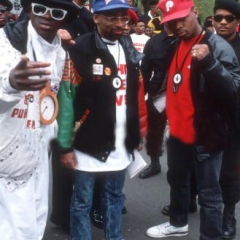
Public Enemy is an American hip hop group formed in 1982 in Long Island, New York. Considered one of the most influential groups in the history of the genre, they are known for their political and social approach to rap, with lyrics that denounce systemic racism and social injustices. Influenced by artists like Curtis Mayfield and Gil Scott-Heron, Public Enemy carried on the tradition of 'message music' incorporating elements of funk, jazz, and rock into their music. The group primarily consists of Chuck D (vocals), Flavor Flav (co-vocals and percussion) and Professor Griff (political advisor). Among their most representative songs are "Fight the Power", "Bring the Noise" and "Black Steel in the Hour of Chaos". Public Enemy has released numerous successful albums, including "It Takes a Nation of Millions to Hold Us Back" (1988) and "Fear of a Black Planet" (1990), both considered masterpieces of the genre. Their cultural impact has been enormous, contributing to defining hip-hop as a political and social force.

 Matthew Dear
 Kiss
 Brettell
 Albennie Jones
 Utopia
 Luti-Kriss
 Sadat X
 David Frizzell
 The Beautiful Mistake
 Ricky Fanté
 Buffy
 Lobo